
Guest Analysis: Softball Interview of Grace City Church Leader Falls Short of Rigorous Journalism
Software programmer and mechanical engineer Edward Martinez analyzed the interview and breaks it down in this guest analysis

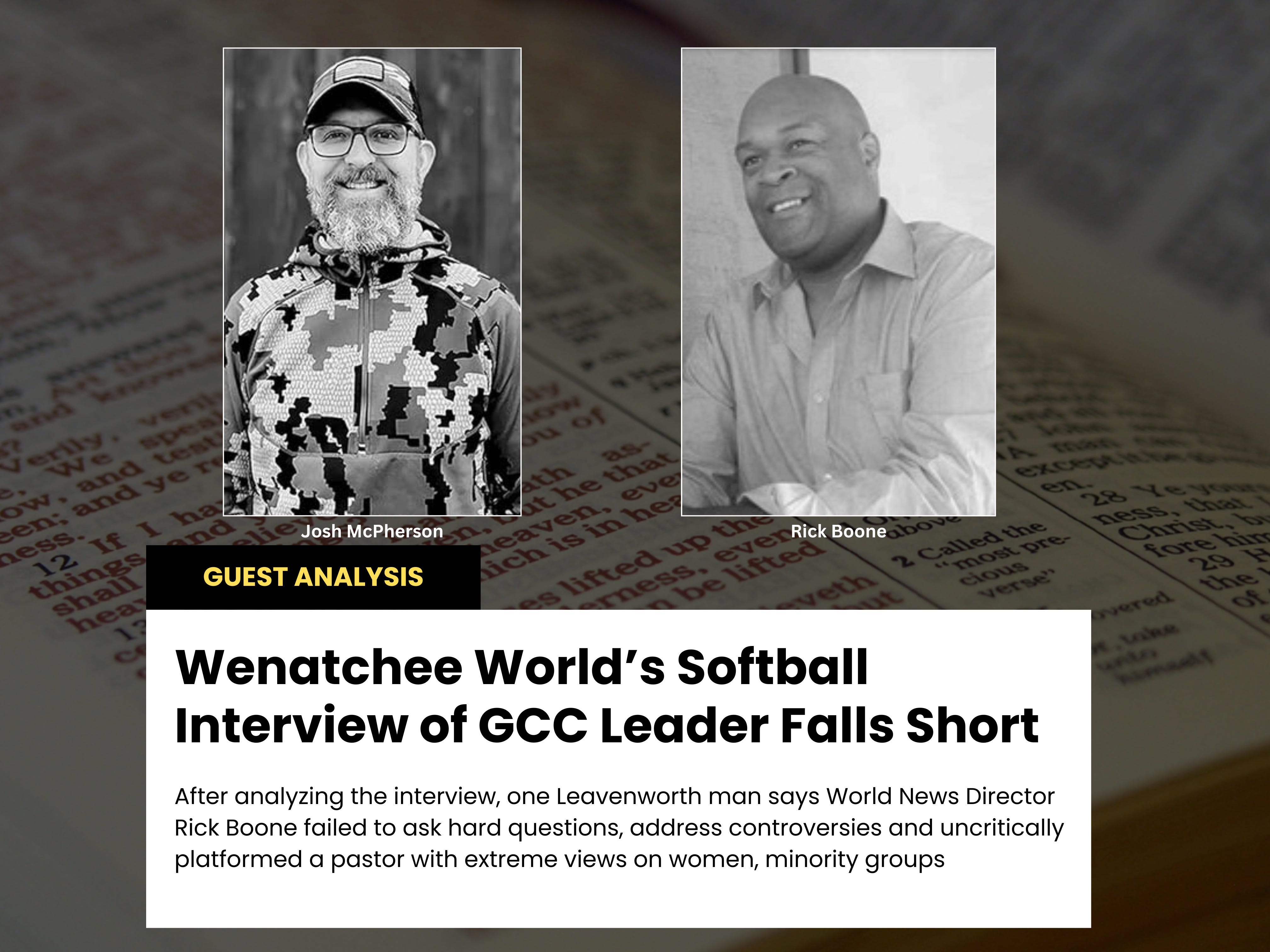
Publisher’s note: If you had not seen it yet, the Wenatchee World/NCWlife recently posted a video interview with Grace City Church Pastor Josh McPherson conducted by the Wick Communication property’s new news director, Rick Boone. It’s behind the World’s paywall, but if you have not seen it and would like to prior to reading this guest submission you can do that here.
For many, the interview with the reclusive and controversial pastor fell short. McPherson does a vast majority of the talking and Boone doesn’t ask any difficult questions, save one about ICE. Obviously I took note of it, and decided I would not personally write something pointing out the interview’s obvious flaws.
But Leavenworth resident and longtime programmer Edward Martinez created this analysis and critique that I felt was concise, neutral and well worth publishing. It’s important, now more than ever, for journalists not to allow their platforms to be used to amplify lies, half-truths and disingenuous propaganda meant to Trojan horse anti-democratic and bigoted ideologies to new audiences.
McPherson is an adept communicator and changes his message to suit the audience. With Boone he played the part of a simple small town pastor getting picked on for simply preaching the gospel, and the seasoned journalist did nothing to dig deeper and attempt to speak truth to power by questioning McPherson’s controversial remarks that empathy is sin (which got national news coverage), his belief that women’s bodies do not belong to them or his labeling of the LGBTQIA+ community as “pedophiles” and comparing them to dogs and cats who will burn in hell for eternity if they don’t think like he does.
He didn’t ask about McPherson’s bullying of his own followers, belittling the men in his congregation by calling them “gay sex men” for not giving him enough money. Nor did he ask about McPherson’s casual references to extreme acts of sexual assault, comparing himself to the victim of a mop-handle rape because he is a pastor in Washington state. And we’re just scratching the surface of all the extreme, bigoted and flat-out strange things McPherson has said or done.
But with no further preamble I will let Mr. Martinez continue, because I do think that he brings a fresh perspective to the subject while breaking the interview down in a systematic way that is easy to understand and digest. And for full disclosure, he did use Advanced AI tool called Claude 4.7 to help with the research and polish his writing.
An Analysis of the Wenatchee World’s interview with Grace City Church Pastor Josh McPherson
By Edward Martinez
Grace City Church Pastor Josh McPherson sat down recently for a long-form video interview with Rick Boone of the Wenatchee World — the paper billed it as an “exclusive” look “inside Grace City Church.” I pulled the audio, transcribed the full 36 minutes, and ran it through three layers of analysis: a fact-check on his specific claims, a breakdown of what the journalism did and didn’t do, and a deeper look at the political and theological worldview he’s operating from.
I can’t share the transcript itself — that’s the Wenatchee World’s content — but the substance is fair game, and there’s a lot of it worth talking about.
On The Facts
Most of McPherson’s autobiographical and institutional claims check out. But several don’t. He cited a “Washington Business Association” statistic — first, the organization is actually the Association of Washington Business, and second, his “48% of businesses leaving” number is roughly double the real figure (24%). His Thomas Jefferson “led a church in the Capitol” claim is the David Barton/WallBuilders version of history; Jefferson attended services there, he didn’t lead them. And he described the 2020 Cuevas v. Inslee COVID lawsuit as his political awakening without mentioning that it lost decisively in Chelan County Superior Court three months after it was filed.
On The Omissions
Some of what wasn’t said matters more than what was. McPherson introduced Adam James — running for state rep in LD 12 — as “a good friend.” He didn’t mention that James is a founding member of Grace City, on the church’s leadership team, was a co-plaintiff alongside him in the Inslee suit, and raised $200,000+ from Grace City donors on the day he launched his campaign. McPherson also didn’t mention that he visited the Trump White House during the first 100 days of the second administration as part of the White House Faith Office’s pastor outreach, or that Grace City accepted $241,000 in forgiven PPP money in 2020 while suing the state over pandemic restrictions, or that the FreedomCon event he was promoting features Mark Driscoll — twice removed from his own churches by his own elders for documented patterns of abuse — as a marquee speaker.
On The Journalism
This was not accountability journalism. It was a 36-minute Q&A in which the subject spoke roughly 90% of the runtime, was never asked to verify a statistic, never confronted with a specific critic by name, and explicitly praised the interviewer at the end for not being like other journalists. Boone tried once to land a real follow-up — on whether churches should endorse increased ICE arrests — and McPherson pivoted away from the question without answering it. Boone didn’t return to it. The closing exchange has McPherson praising Boone’s methodology on camera and Boone accepting the praise. That’s the moment that tells you what kind of interview this was.
On The Worldview
McPherson is a careful, articulate operator inside a specific national religious-political movement — Reformed Christian nationalism in the Moscow, Idaho (Doug Wilson / CrossPolitic) orbit, with a Kuyperian theological framework and a Christian-nation reading of the founders’ intent. The Stronger Man Nation ministry, FreedomCon, the pastor-to-pastor coordination across Washington state, and the James campaign are not separate projects. They’re a coordinated infrastructure for converting religious authority into political organization, with Grace City as the local base. The interview is documentary evidence of that project being assembled in real time.
The Closing Exchange
The end of the interview is where the platform character becomes undeniable. Boone’s final question gives McPherson the floor to characterize the interview itself:
“How do you now address people who may have either criticism or love towards you, what’s your feeling, what’s your vibe? Are you going to be different? Is there a different Josh McPherson after this interview, or is it the same guy?”
McPherson uses this opportunity to praise Boone for not being like other journalists:
“I was just, I think, refreshingly taken back by your willingness to let me speak on my own, in my own voice, with my own words, and no desire to reframe it, to twist it. I’ve lost track of times I’ve been misquoted in articles... I just hand’s hat off to you for I think bringing maybe a new perspective to our valley that maybe journalism has had in a while. It’s honorable, it’s admirable, and I think it’s going to change the tone of our valley and I’m grateful for that.”
Boone responds: “Pastor Josh McPherson, thank you very much for this conversation.”
That exchange is the give-away. The subject is endorsing the journalist’s methodology on camera, and the journalist accepts the endorsement. The framing of “real journalism = letting subjects speak in their own voice without reframing” is McPherson’s framing, not journalism’s framing. Journalism’s framing is that subjects speak in their own voice and the reporter provides context, checks claims, and represents perspectives the subject doesn’t volunteer. McPherson is praising Boone for doing only the first half of that job, and Boone is accepting the praise.
What This Interview Is
It’s a long-form Q&A in which a public figure with significant local and growing national political influence presented his worldview, ministry, and political project without a single fact being checked or a single critic being represented. The Wenatchee World framed it as “exclusive” and “inside,” which is the language of access journalism. The video runs alongside a 29-word written article and no contextualizing reportage.
The interview is newsworthy in the sense that the things McPherson said are facts about what he believes and what he’s organizing. For that reason alone, the video has value — it puts on the record, in his own voice, his political theology, his church-as-political-organizing-base strategy, his alignment with the Moscow-orbit men’s-conference circuit, and his explicit endorsement of a state house candidate. Those are useful primary sources for anyone trying to understand the political landscape of Chelan County and LD 12.
But it is not accountability journalism. It is closer to a long-form campaign video that the candidate’s own staff couldn’t produce because the subject is a 501(c)(3) pastor rather than a candidate, and the value of having it appear on the Wenatchee World’s platform — rather than on Stronger Man Nation’s YouTube channel — is precisely the laundering of access into apparent journalistic legitimacy.
A serious follow-up piece by the Wenatchee World would look like this: a reported article that uses this interview as one source, alongside the Cuevas v. Inslee record, the Dominick Bonny reporting archive, the AWB survey data, the Adam James campaign finance filings, former GCC members willing to speak on the record, and a paragraph noting Grace City’s $241,000 in forgiven PPP funds. The story isn’t “McPherson is bad.”
The story is “here is what a growing political infrastructure looks like in Chelan County, here is who’s in it, here is how it’s funded, and here is what its public face says when given a friendly platform.” That’s the piece that would make the interview newsworthy. Without it, the interview is the platform.
Great insight and I really hope wenatchee world sees this and takes this advice for a follow up article. Anything less is haphazard, lazy, and biased.
FreedomCon is appropriately named. It is first and foremost a con, just like GCC and Christian Nationalism in general. And the rubes just keep opening their wallets.